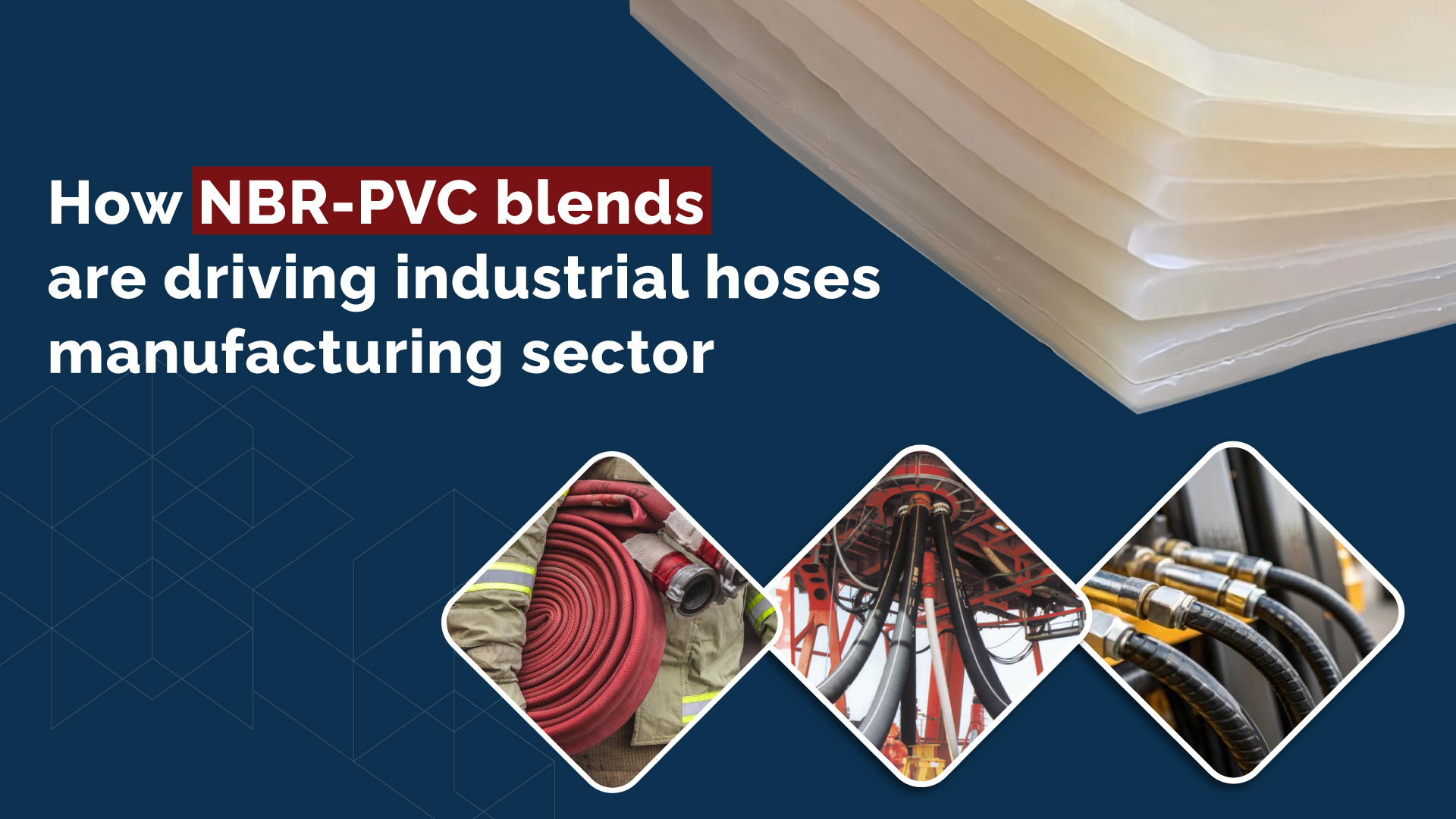
NBR-PVC Blends in Hose Manufacturing: Applications Driving Market Growth
A single hose failure in an automotive assembly line can cost thousands in downtime. In construction, a ruptured hydraulic hose on heavy equipment means halted projects and safety risks. For manufacturers, the choice of hose material isn't just technical—it's strategic. Enter NBR-PVC polyblends , the compound behind hose performance across industries.
The Material Science Behind the Growth
In NBR-PVC, NBR's fuel and oil resistance combined with PVC's ozone resistance and durability. The result exceeds the sum of its parts: compounds that resist oil, chemicals, abrasion, weather, and ozone while maintaining flexibility and processability. Unlike elastomers that solve specific problems at a high cost, NBR-PVC delivers broad-spectrum performance at accessible price points.
Within the broader industrial hose market NBR-PVC compounds are capturing expanding share across automotive, industrial, and construction segments.
Automotive Applications: Meeting stringent Standards
The automotive sector represents NBR-PVC's largest application domain, driven by OEM adoption to meet emission and efficiency regulations. Modern fuel systems demand hoses that resist permeation while enduring temperature cycles and aggressive fuel formulations. Formulations with 70:30 polymer ratios at Shore A 70-75 hardness deliver the requisite fuel resistance and mechanical integrity.
Automotive hoses in Petrol, Diesel, E20 and Fuel systems face extreme pressure. NBR-PVC compounds excel here through careful tuning of acrylonitrile content—typically 33% for balanced oil resistance with PVC and reinforcing fillers. The inner lining requires different properties than the outer cover: higher oil resistance and slightly softer durometers for the lining, enhanced abrasion resistance and weather protection for the cover.
Air intake hoses benefit from NBR-PVC's ozone resistance, a critical advantage over conventional nitrile rubber. As vehicles age, ozone cracking compromises pure NBR hoses, but the PVC component in polyblends provides inherent protection. This durability translates to growing aftermarket demand as workshops recognize the lifecycle value despite marginally higher initial costs.
Industrial Hoses: Durability Under Demand
Heavy industries—mining, manufacturing, construction equipment—subject hydraulic hoses to punishing conditions: high pressures, temperature extremes, contaminated environments, and constant flexing. NBR-PVC formulations address these demands through strategic compounding. For example phenolic resins at 8 phr enhance oil resistance and compression set performance. Carbon black loading (N550 or N330 grades at 35 phr) and / or Silica improves abrasion resistance while maintaining flexibility.
Chemical transfer hoses showcase NBR-PVC's versatility. By adjusting the NBR-to-PVC ratio and selecting appropriate plasticizers, manufacturers create grades resistant to specific chemical classes. Phthalate-free formulations now dominate export markets, meeting REACH compliance requirements for European and North American customers. This regulatory shift initially challenged producers but ultimately expanded market access for compliant manufacturers.
Oil and fuel handling in industrial settings demands compounds that resist swelling while maintaining mechanical properties. Volume change testing in ASTM Oil 3 at 100°C over 48 hours typically shows 12-15% swell for well-formulated NBR-PVC grades—acceptable performance that balances cost and function. The material's impermeability prevents contamination, a critical factor in food processing and pharmaceutical manufacturing where hose integrity directly impacts product safety.
Fire and Safety Applications: Built-In Protection
Fire hoses exemplify NBR-PVC's inherent advantages. The PVC component provides natural flame retardancy, eliminating the need for extensive additive packages required in other elastomers. Formulations incorporating aluminium trihydrate at 80 phr and chlorinated paraffin at 30 phr achieve self-extinguishing behavior while maintaining the flexibility emergency responders require.
These hoses must survive long storage periods exposed to weather and ozone without degradation. NBR-PVC's combined weather resistance and ozone stability ensure reliability when seconds count. Testing at 50 pphm ozone concentration over 70 hours with 20% strain shows no cracking—performance unmatched by conventional rubbers at comparable cost.
LPG hoses and other fuel gas applications demand similar properties: fuel resistance, weather durability, and safety compliance. The material's electrical insulation properties add value in applications where static discharge poses explosion risks. Shore A hardness around 70-75 provides the mechanical strength for pressure retention while allowing sufficient flexibility for installation and use.
Innovation Addressing Tomorrow's Demands
The push toward sustainability is reshaping NBR-PVC formulation strategies. Manufacturers are developing more recyclable compounds and exploring bio-based plasticizers to reduce environmental footprint. Phthalate-free grades, once specialty products, have become mainstream as regulations tighten globally.
Process efficiency improvements are lowering production costs. Better stabilization packages reduce material waste during mixing and extrusion. Controlled compound viscosity—typically Mooney values between 50 and 75 depending on application—optimizes processability without sacrificing final properties. Vacuum extrusion eliminates air entrapment, improving hose appearance and reducing defect rates.
Regional dynamics shape market growth. Asia-Pacific leads demand growth, fueled by automotive production expansion and infrastructure investment. North American markets emphasize compliance and performance, driving premiumization trends. Manufacturers serving global markets maintain diverse grade portfolios covering hardness ranges from 30 Shore A for specialized printing applications to 90+ Shore A for high-durability printing rollers and seals—versatility that positions NBR-PVC as a platform technology rather than a niche material.
Strategic Selection for Manufacturers
Choosing the right NBR-PVC grade requires matching compound properties to application demands. Key considerations include acrylonitrile content (affecting oil resistance), polymer ratio (balancing cost and performance), and specific gravity (impacting weight-sensitive applications). Manufacturers benefit from suppliers offering comprehensive technical support, detailed formulation guidance, and consistent quality across production batches.
Testing validates performance before full-scale production. Beyond standard tensile and elongation measurements, application-specific testing—hot air aging, oil immersion, ozone resistance—confirms real-world durability. Chrome-plated molds reduce fouling during production, while proper cure cycles (typically 155-175°C for compression molding) ensure complete crosslinking without scorching.
The Road Ahead
NBR-PVC polyblends occupy an expanding space in the global hose market, delivering performance that bridges the gap between commodity rubbers and specialty elastomers. As automotive efficiency standards tighten, industrial operations demand greater reliability, and safety regulations evolve, the material's balanced property profile positions it for sustained growth.
For hose manufacturers, the opportunity is clear: A hose market with NBR-PVC compounds gaining share across segments. Success requires understanding formulation nuances, maintaining quality consistency, and partnering with suppliers who view material science as competitive advantage. In an industry where failure is costly and performance is non-negotiable, choosing the right compound isn't just engineering—it's strategy.