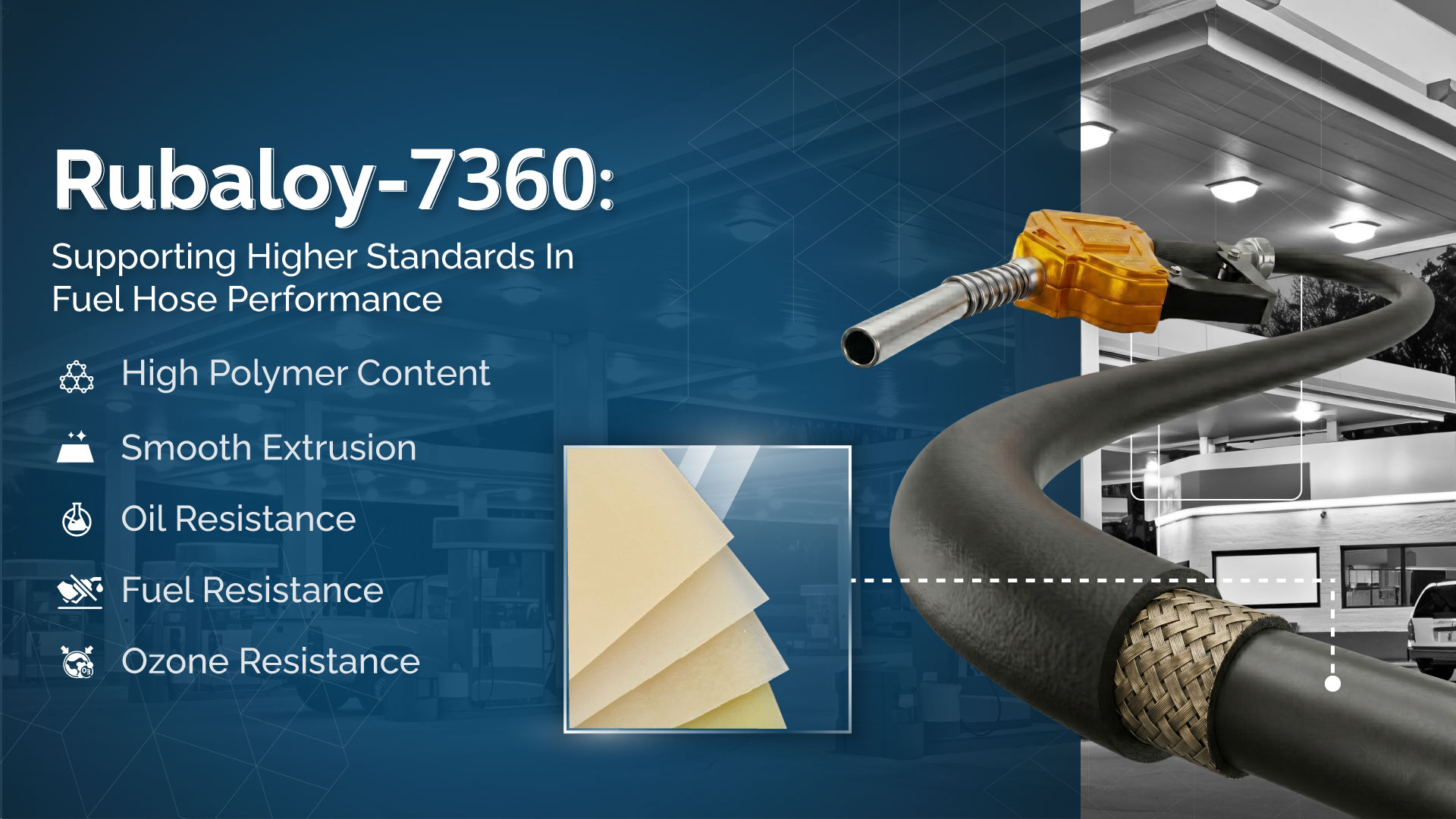
Rubaloy-7360: Supporting Higher Standards In Fuel Hose Performance
Studies suggest that material degradation may contribute significantly to hose failures in fuel transfer systems, highlighting the importance of compound stability for long-term hose performance.
Fuel hose performance is no longer evaluated solely by fuel resistance; increasing attention is also being given to long-term material stability and longevity. With growing demand across automotive, industrial, and fluid-transfer applications, expectations placed on fuel hoses continue to evolve.
Modern hoses are usually exposed to hydrocarbons, high and low temperatures, mechanical stress, and continuous service for long periods of time. Therefore, how the hose is manufactured is critical to the performance of the hose.
Advanced formulations like Rubaloy-7360 can offer benefits because they focus on not only resistance but also long-term stability with a high level of polymers.
The Real Challenge: Stability Over Time
A hose's lifespan really comes down to the stability of its polymer system. When materials start to break down, harden, or lose their flexibility, they're prone to cracking or leaking, which isn't just a performance issue—it's a safety risk.
That’s why manufacturers need to look for blends that can actually keep their original properties, even after years of being in constant contact with fuel.
Rubaloy-7360 has been developed as a high polymer content NBR PVC rubber sheet with minimal plasticizer content, so it will help maintain the same mechanical and chemical properties for its entire life cycle and reduce the risk of excessive migration of softener or unstable formulation.
As a result, there appears to be increasing industry interest in formulations that prioritize longevity, reliability, and performance consistency.
The Role of Elastomer Compounds in Fuel Hoses
Fuel hoses are used in very harsh environments that are constantly exposed to fuels, oils, and hydrocarbon vapors. Due to constant exposure to these chemicals, they will deteriorate over time if the compound is not formulated properly.
Since the hose functions as a critical barrier between fuel and the surrounding environment, the material should ideally maintain structural integrity under prolonged exposure.
Elastomer compounds are typically developed to balance:
- Fuel resistance
- Mechanical strength
- Flexibility
In formulations such as Rubaloy-7360, this balance is supported through a 70:30 NBR PVC polymer blends, where
- The NBR phase contributes to fuel and oil resistance
- The PVC phase supports structural stability
This combination can help the blend perform reliably under pressure, vibration, and repeated bending while supporting long-term integrity.
Conventional Plasticised Grades vs High-Polymer Content Grades
Plasticizers are traditionally used to improve flexibility, allowing hoses to bend more easily during use and processing. However, in certain fuel hose applications, higher levels of plasticizer may present long-term limitations. Over time, some plasticizers can migrate from the polymer matrix due to factors such as:
- Fuel exposure
- Temperature variation
- Operational stress
This migration may contribute to:
- Reduced flexibility
- Increased brittleness
- Surface cracking
- Lower material stability
- Potential contamination in sensitive systems
When the plasticizer levels decline, the hoses may become more vulnerable. The Rubaloy-7360 is designed with a high polymer base, offering long-term consistency while reducing dependence on softening systems.
Why the Industry Is Exploring High-Polymer Content Materials
With fuel hose standards getting tougher, manufacturers are really focusing on materials that can go the distance and keep performing consistently year after year.
While compounds with lots of plasticizers work well enough at first, they often start to stiffen or lose their strength over time.
The rubaloy NBR‑PVC Polymer Blends offer a more stable polymer matrix that can:
- Resist degradation under continuous fuel exposure
- Maintain mechanical integrity
- Reduce variability in performance
This aligns with the industry’s growing focus on customization, efficiency, and long-term reliability.
Rubaloy-7360: A High-Polymer Content Option for Fuel Hoses
Rubaloy-7360 is a high-polymer 70:30 NBR PVC blend designed for fuel hose applications.
Unlike conventional highly plasticized formulations, it is designed to deliver inherent stability within the polymer structure, helping key properties remain more consistent throughout the product lifecycle.
Key Strengths of Rubaloy-7360
Long-Term Stability
Supports retention of flexibility, strength, and dimensional integrity through a robust polymer-rich formulation.
Fuel & Oil Resistance
The NBR-PVC phase contributes strong resistance to hydrocarbon interaction, making it suitable for fuel transfer systems.
Reduced Degradation Risk
Helps reduce cracking, hardening, and performance loss over time.
Processing Efficiency
Rapid absorption of fillers and performance additives during manufacturing may contribute to:
- Shorter cycle times
- Lower energy consumption
- Improved production efficiency
- Extrusion Performance
Designed to support:
- Good extrudability
- Smooth surface finish
- Consistent shape retention
Conclusion
The future of modern fuel systems is evolving, and now the expectation from fuel hoses has gone beyond just resistance to all factors of fuel hose usage, thus ensuring consistent performance and long-term stability.
As a result, more businesses are turning to advanced materials to avoid the common pitfalls of traditional, heavily plasticized formulas.
Switching to high-polymer NBR PVC blends is a great way to reach that standard. Rubaloy is one of India’s Largest Manufacturers of NBR‑PVC blend, known for oil resistance, longevity, and consistent industrial performance.
Disclaimer
The information provided in this write-up is intended for general product awareness and technical discussion purposes only. All statements regarding performance, processing behaviour, suitability, and potential benefits of Rubaloy-7360 are based on internal understanding, formulation design intent, and general industry experience, and should not be interpreted as absolute guarantees or specifications.
Actual performance may vary depending on compounding methods, processing conditions, hose design, operating environment, service media, curing systems, and end-use application requirements.
We strongly recommend that you run your own tests and assessments under real-world production and service conditions before moving to commercial use.
Any references to industry standards or classifications indicate potential applicability only and do not constitute certification unless specifically confirmed through finished compound testing. Specifications are subject to change without prior notice.